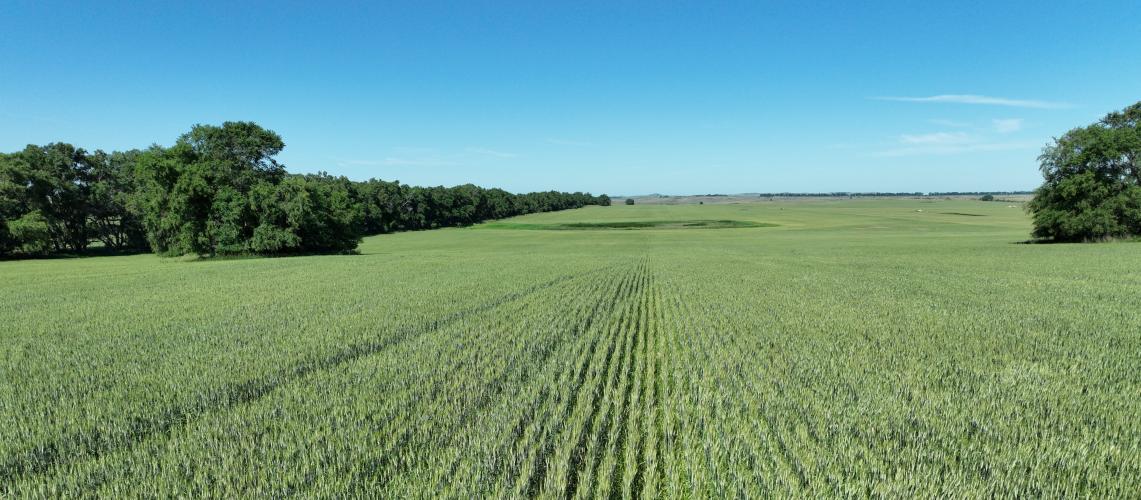
What Is Your Farmland Really Worth?
Why an Appraisal and an Auction Can Give You Two Different Answers
I spend a lot of time valuing farmland.
And the longer I do this, the more respect I have for good farm appraisers because their job is harder than most people realize.
We have better information today than we've ever had. We can pull up soil maps, productivity indexes, aerial photography, FSA information, wetlands, topography, drainage, tax information and years of comparable sales.
All of that helps.
But there is one thing none of those maps can show you:
How motivated are the buyers for your land?
That's where farmland valuation gets interesting.
Are Comparable Sales Really Comparable?
The sales comparison approach is one of the main tools used to appraise farmland. The concept makes perfect sense. Find recent sales of similar properties, look at the differences and use those sales to help establish a value.
But finding a truly comparable farm isn't always easy.
Two 160-acre farms in the same township can have similar soils, similar tillable acres and similar productivity and still sell very differently.
Why?
Maybe the tenant bought one.
Maybe a neighbor had been waiting 30 years for the opportunity to buy it.
Maybe it connected two pieces of an existing operation.
Maybe someone had a 1031 exchange deadline approaching and needed to place money.
Maybe a buyer had just sold another property and was sitting on cash.
Maybe Dad told his son years ago, "If that quarter ever comes up for sale, buy it."
Maybe two neighbors simply decided they weren't going to let the other one have it.
Try putting all of that into an appraisal spreadsheet.
You can't.
And that's not a criticism of the appraiser.
It's just reality.
The Information an Appraiser Can't Possibly Know
A good appraiser can verify a sale price and study the property.
They can look at soils, access, drainage, productivity, location, improvements and the terms of the transaction. They can even talk to people involved with comparable sales and try to understand what was going on at the time.
But there is a limit.
Imagine trying to interview every serious bidder after an auction.
Why did you bid $7,500?
Why did you stop at $7,400?
Would you have gone another $500 if the other bidder hadn't quit?
Was this the last land purchase your lender would allow this year?
Did owning the adjoining quarter make this farm worth $1,000 an acre more to you?
Did you have money that needed to be reinvested?
Was this strictly an investment, or did you just really want the farm?
And even if you asked all those questions, would people tell you the whole story?
Probably not.
Buyer motivation is real, but it is incredibly difficult to measure.
That's why I don't think it's fair to expect an appraiser to predict exactly what a farm will bring when it is exposed to the market.
Their job is to analyze the information that exists.
They can't measure a buyer who hasn't entered the picture yet.
The Tenant and Neighbor Factor
I think this is one of the most underestimated parts of farmland valuation.
Who farms it now?
Does the tenant want to own it?
Can the tenant afford to buy it?
Are there two strong neighbors or ten?
Does the property solve a problem for somebody?
Maybe it gives a neighboring farmer better access.
Maybe it connects two farms.
Maybe it improves drainage.
Maybe it adds acres close to a headquarters, grain system or livestock operation.
Those things can create additional value to a particular buyer that isn't always visible in a traditional appraisal.
The opposite can happen too.
A farm can look fantastic on paper but have very few natural buyers.
That tells us something too.
Then There Is the 1031 Buyer
A 1031 exchange is another great example.
A buyer who just sold another investment property and is working within the rules and deadlines of a 1031 exchange may look at your farm differently than a farmer financing the purchase from operating income.
That doesn't mean the 1031 buyer is going to overpay.
It simply means they may have a different motivation, a different timeline and fewer alternatives.
How does an appraiser know if that buyer is going to show up when your farm is sold?
They don't.
Neither do I.
That's why we have auctions.
An Appraisal Is an Opinion of Value. An Auction Tests the Market.
There is an important distinction here.
An appraisal isn't supposed to predict the exact winning bid at an auction.
It is a professional opinion of value based on market evidence, the characteristics of the property and recognized valuation methods.
And that opinion can be extremely valuable.
Appraisals are needed for estates, financing, tax planning, litigation, ownership transfers and plenty of other reasons. A professional appraiser has to support their conclusions with credible information.
But when an owner asks me:
"What will my farm actually sell for?"
My answer is usually a range.
Because until we expose that particular farm to qualified buyers, none of us knows exactly where the market is.
That's why I believe a well-run public auction is the truest form of price discovery.
We advertise it.
We educate buyers.
We give them time to do their homework.
We reach the tenant.
We reach the neighbors.
We reach investors.
We reach 1031 buyers.
Then we put all of those different motivations into competition with one another.
At that point, we aren't estimating demand.
We're watching it happen.
What Happens When the Auction Doesn't Match the Appraisal?
This is where things can get uncomfortable.
Suppose your farm was appraised at $1 million six months ago.
You take it to market and the highest bid is $800,000.
Now what?
Was the appraisal wrong?
Not necessarily.
Was the auction wrong?
Not necessarily.
The first thing I would do is regroup and ask some questions.
What feedback did the agent get?
Did we reach the logical buyers?
Were the tenant and adjoining landowners engaged? If they weren't interested, that tells us something too.
Did something change in the market?
Were there terms affecting the sale? Maybe there was a lease in place. Maybe the seller was retaining aggregate rights or there was some other condition that made the property less attractive.
And perhaps most importantly:
Was there really money left on the table?
The Highest Price Is the Goal, But What Else Are We Trying to Accomplish?
Of course we want to get the highest possible price.
But there is usually a reason the property is being sold in the first place.
Is it to split up joint ownership?
Increase cash flow?
Help pay for Mom or Dad's care?
Part of an estate or tax plan?
To complete a 1031 exchange?
Sometimes the bigger question isn't simply, "Did I get the appraisal price?"
It is, "Does selling at the price in front of me accomplish what I'm trying to accomplish?"
If selling the property improves your situation going forward, then even a price below an earlier appraisal may still make sense.
That's worth thinking about.
Use the Appraisal for What It Does Best
I don't think landowners should distrust appraisals.
Quite the opposite.
A good agricultural appraisal can be an incredibly useful tool.
What I wouldn't do is expect an appraiser to know things that nobody could reasonably know.
They can't know whether the neighbor's wealthy aunt just left him some money.
They can't know whether somebody needs your farm to complete a 1031 exchange.
They can't know whether the tenant has quietly decided this is the one farm he absolutely wants to own.
And they certainly can't know whether two bidders are going to decide on auction day that neither one wants to quit.
Those aren't soil characteristics.
They're human characteristics.
And at the end of the day, human beings buy land.
Start With a Range, Not a Promise
When I'm talking with a landowner before a sale, I would much rather give them a realistic range than convince them of one exact number.
Maybe I believe a property has a reasonable selling range of $6,500 to $7,500 per acre.
Could it bring $8,000?
Absolutely.
Could it stop at $6,200?
It could.
My job isn't to guarantee which number will appear.
My job is to understand the property, study the market, identify the likely buyers, create the best marketing plan we can and put those buyers in a position to compete.
That conversation before the sale is important.
It can be the difference between a seller understanding the final result and being disappointed because someone convinced them months earlier that their farm was worth one exact number.
An appraisal gives us an educated and supportable opinion of value.
A good land professional adds current market knowledge and can help establish a realistic range of potential selling prices.
Then, when the circumstances are right, a well-run auction lets the market answer the final question:
What is this farm worth to the buyers who can actually buy it today?
Sometimes the answer will be below the appraisal.
Sometimes it will be right on it.
And every once in a while, two motivated buyers will remind all of us why farmland can be so darn hard to value.
Author: Steve Link is a Partner and Land Broker with Pifer's Auction & Realty, specializing in agricultural land sales, auctions, valuations, and transition planning throughout North Dakota, Minnesota, South Dakota, Montana, Iowa, and Nebraska. Whether you're considering selling, planning for the next generation, or simply want to better understand your land's value, Steve believes the best decisions are made with good information and thoughtful planning.